The Teen Years: Phallic Towers in the Valley of the Dolls (Updated April 2026)

Thanks to everyone who is following my reading journey. If you missed my previous musings, links are at the end of this post.
valley3One day in 1966, when I was in the 8th grade, I was perusing the rental shelf (5 cents per day, if I remember correctly), when my eyes spied a book I had recently heard about, the groundbreaking Valley of the Dolls by Jacqueline Susann. When I took it to the desk, Miss Clark looked at it with her gimlet eye (and even though she was very nice, she always looked at my adult books with this kind of an “eye”) and said I needed a note from my “mommy” to check it out. What happened after that shaped my reading life forever.

But before that happened…

Gothic Love

After I finished the “teen” books in our small library, I asked Miss Clark what I should mellynread next, and she recommended Mistress of Mellyn by Victoria Holt. I wish Miss Clark were still alive so I could thank her for how she changed my life. First of all, I was so enamored of the story, setting, and shocking revelation at the end that to this day, there’s nothing I like better than a good Gothic novel with a creepy manor setting, a sense of unease, and a twist that knocks my socks off. And secondly, her help made me realize how much fun it can be to help someone find just the right book for their reading pleasure.

I went to read the rest of Victoria Holt‘s oeuvre, including Bride of Pendorric, The Legend of the Seventh Virgin, Kirkland Revels, and more. After that, I scoured the shelves for books by other authors with covers featuring terrified women fleeing manor houses with menacing towers, or other dark, foreboding dust jackets that would send chills down my spine. I read books by Phyllis Whitney, Dorothy Eden, Mary Stewart, Barbara Michaels, and anything else with phallic symbols on the cover.

iPiccy-collage gothcsYes, that’s right. Did you know that back when gothic novels were “hot,” book cover artists were instructed to create covers with towering phallic symbols? Who knew? You can read all about it in my review of Grady Hendrix’s Paperbacks from Hell.  Hmm, maybe the subliminal message went into my subconscious, which may have influenced my next reading obsession…

The Blue Years

When Miss Clark told me I needed a special note to check out Valley of the Dolls, I must have looked at her with puppy dog eyes and said something like, “Oh, Miss Clark, you’ve known me for a long time. May I please take it today?” And she relented. I was absorbed from start to finish, and, quite frankly, I can’t tell you anything about the plot or characters. I’m sure some issues went over my 13-year-old head, but I was ready to read more of this kind of book. I’m sure by today’s standards, the content would be relatively mild (and I did end up reading worse a few short months later, but I’ll get to that in a minute), but it was reasonably risqué for that time.

iPiccy-collage robbinsAfter that, it was a short coaster ride down the slippery slope to reading more smut. It wasn’t long before I discovered novels by Harold Robbins, such as The Carpetbaggers, but my favorite was The Adventurers, where I even learned a few “bad” words in Spanish. Heh.

(If you have read his books and have the time, this 2019 article about Harold Robbins is fascinating.)

Then my stepmother started watching the TV series based on Grace Metalious’ shocking Peyton Place, so how could I resist getting the book, which was described as “…a tale that includes incest, abortion, adultery, lust, and murder.” Hooboy! Right up my trashy teen alley! I bought it at the corner drugstore (for 95 cents) and inhaled it along with the sequel, Return to Peyton Place.

Next up were William Goldman’s Boys and Girls Together (the same author who would later write The Princess Bride and Marathon Man), Robert Rimmer’s The Harrad Experiment, and even Kyle Onstoff’s Mandingo (and sequels if I could find them). What can I say? If the paperback had a lurid cover, I would easily part with some of my hard-earned allowances.iPiccy-collage smut

But Where’s the Carnival?

One day during my 8th-grade language arts class, a boy who sat behind me handed me a paperback book to read, and since by now everyone has pretty much noticed I’ll read just about anything, I took it. I don’t remember the full title, but the word “Carnal” was in it (no, it wasn’t “Carnal Knowledge”), and I thought it sounded interesting. Well, it turned out to be pure explicit porn, but that didn’t bother me as much as trying to figure out why the “carnival” was never featured! Silly me, eh? (Side Note: The boy who loaned me the book seemed a little disappointed when I handed it back, saying it was an interesting story. I think he expected me to be shocked.)

(When I was doing readers’ advisory, and a parent expressed concern when a tween/teen wanted to check out a book with “content,” I usually responded that I read Valley of the Dolls when I was 13 and I turned out OK–well, I think I did anyway. I never told them about the “Carnival” book.)

But not everything I read was considered trash. Next post, I’ll get into my late teen years and how a book finally taught me the real “facts” about the birds and the bees.robin 7th grade (2)


The Very Early Years

Chapter Books

Nancy Drew and Chums

The Tween Years


CATCHING UP ON RECENT READS

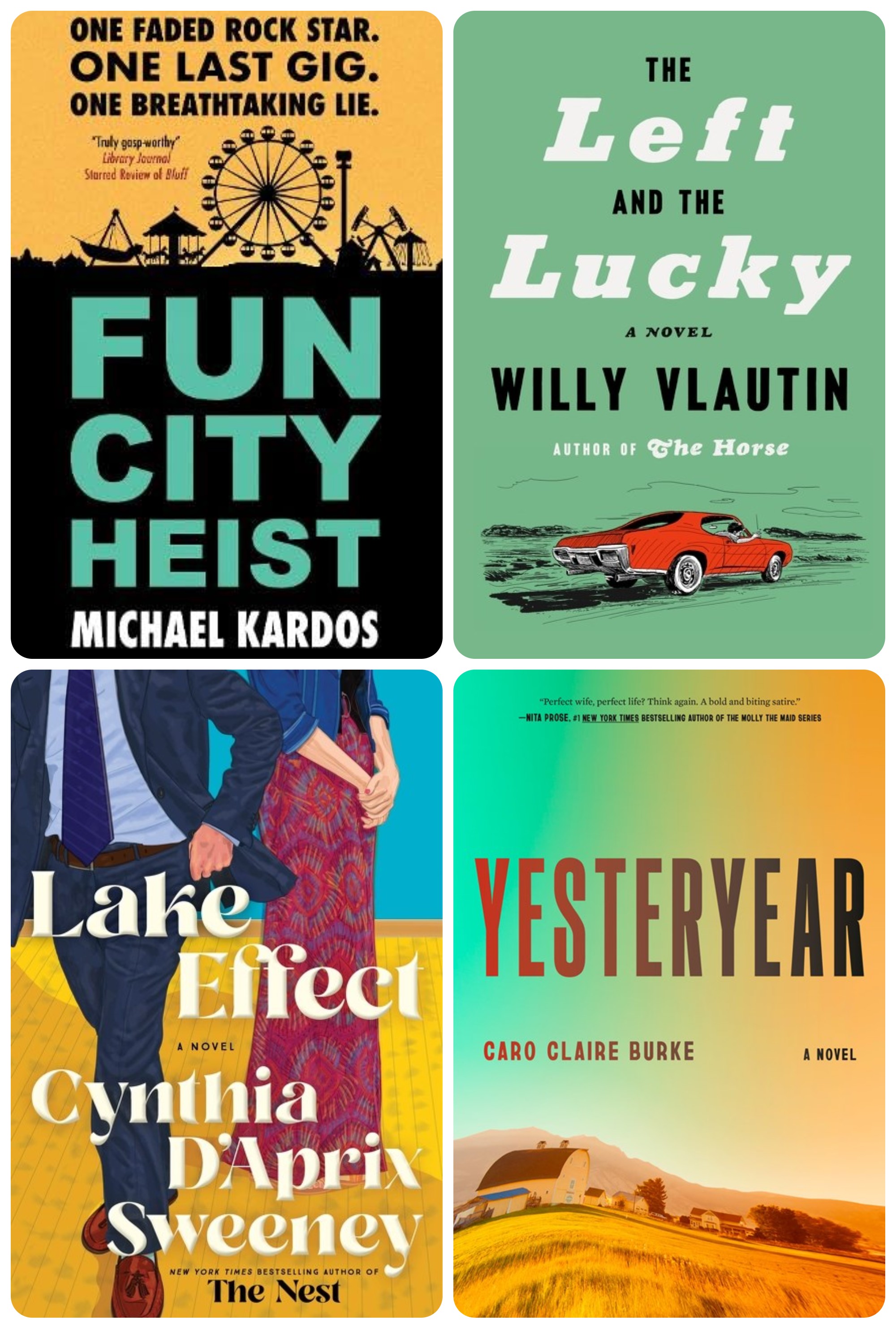
Fun City Heist by Micahel Kardos. I’ve enjoyed this author’s light thrillers, and I’m happy to report this was an extremely fun romp. It’s short, quick, and perfect for those who like a good heist thriller, such as Irwin Shaw’s Nightwork (an oldie, but it is great fun) and the movie Oceans 11. 4 stars

The Left and the Lucky by Willy Vlautin (Oregon author). Willy has once again written an amazing novel about misfits who face the bad odds life has dealt them. Taking place in Portland, this features a hardworking house painter who takes in a neighbor’s boy whose family life is in tatters. If you’ve read Vlautin, you will recognize his talent for tearing your heart apart and then mending it with jagged stitches, and this is no exception. Also, if you’ve read Vlautin, you will wonder about me calling it a “feel-good” story, but this one is – really! A friend compared it to books by Frederik Backman. To be published in mid-April 2026. 5 stars

The Lake Effect by Cynthia A’Aprix Sweeney. This author’s first book, The Nest, remains one of my favorite novels of family dynamics, and this compelling novel about two families torn apart by infidelity and divorce is also well done. This reminded me of Patrick Ryan’s Buckeye, only the pace was a little faster. Readers of Clare Leslie Hall’s Broken Country and Meg Wolitzer’s The Interestings will enjoy this. 5 stars.

Yesteryear by Caro Claire Burke. There is already a lot of buzz about this offbeat novel about a “tradwife” influencer with multiple children living on a big farm (think Ballerina Farm — Google it if needed) and profiting from millions of followers for her depiction of a perfect life. At first, this seemed similar to Marlys Milhiser’s 48-year-old time-travel novel, The Mirror, but it is so much more than that. Definitely a mindbender, and nothing is what it seems. To be published April 7. I could be wrong (and yes, sometimes I am), but it could be big. 4.5 stars

FOUR THRILLERS: Worth Your Time? You Make the Call…

I love a good psychological thriller and was in the mood for more, so I tried these new books, which ultimately left me a little disappointed, especially after reading two barnburners earlier this year (My Husband’s Wife and The One). My thoughts:

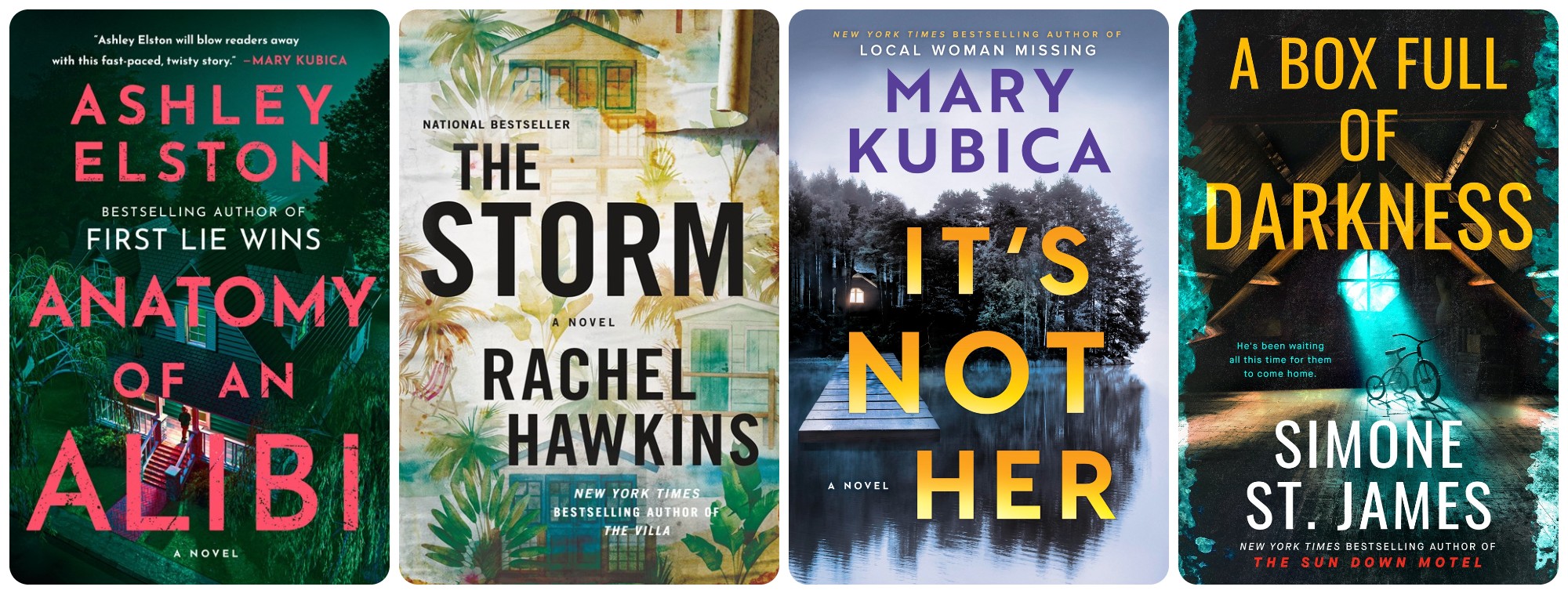
Anatomy of an Alibi by Ashley Elston. I loved her earlier book, First Lie Wins, and was eagerly awaiting her next book. However, it fell flat and was at times tedious, mainly because the timelines jumped around and I got confused about who was who. I skimmed to the end and wasn’t impressed with the ending either. As usual, your mileage may vary; some have loved it, while others felt the way I did.

The Storm by Rachel Hawkins. I enjoyed her earlier book, The Villa, a suspense novel set during the summer Mary Shelley wrote Frankenstein, so I was looking forward to this one. It started out well, with an appealing setting (a small Alabama beach-town hotel) prone to hurricanes and likable characters. It flipped around on the timeline, but it wasn’t confusing, and the finale was fine, not mindbending but it made sense. This would be a good book to read with sand between your toes.

It’s Not Her by Mary Kubica. I read so many good reviews of this, and despite the unappealing characters (especially the two teens), I raced through this. Unfortunately, when it was revealed who caused the murders, my heart sank. I don’t want to say more, but I have a problem with the ones who were responsible and that ruined the ending. I also didn’t care for the final final revelation. But that’s just me… (If you want more of an explanation, send me a message.)

A Box Full of Darkness by Simone St. James. I started this in audio, which was very well done with three separate narrators, but had to finish in book form as my audio loan ended, and that was OK (an occurrence that often happens). I enjoyed her earlier book, The Sun Down Motel, and found the spooky vibes right up my alley (chilling but not gruesome). This is the author’s latest book, and it has a strong premise: three adult siblings return to their childhood home after being summoned by the ghost of Ben, their younger brother, who disappeared when he was six. This had ghosts galore (real ones), and it rolled along fairly well, but the ending was rushed, with no real details about what happened in their childhood. I gave it 3 stars.

HALF HIS AGE by Jeanette McCurdy

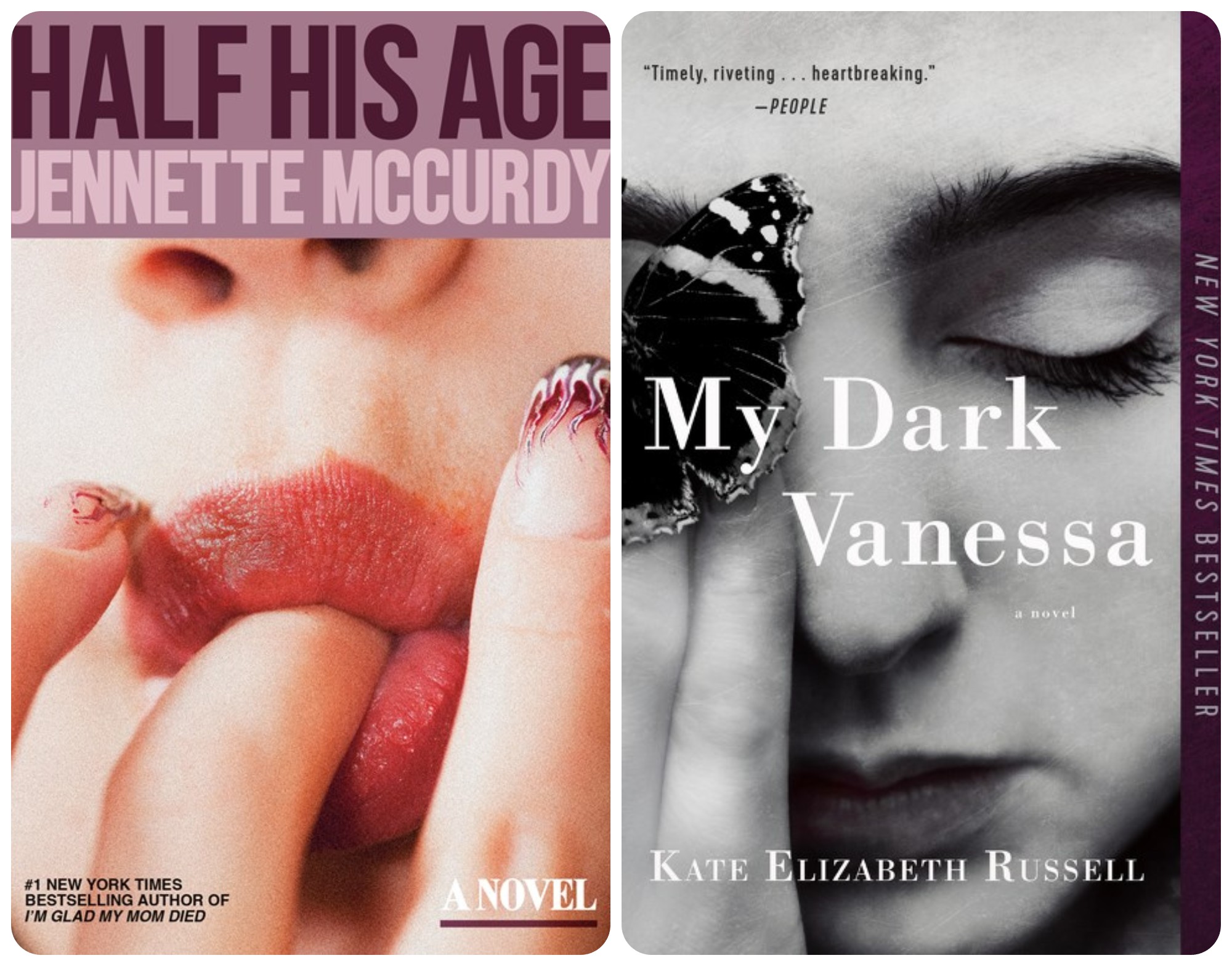
Well, reading this was a wild ride, and this case, I don’t mean that in a good way. The topic (and cover, quite frankly) of Waldo, a high school senior, lusting after her 40-year-old schlubby creative writing teacher (and succeeding) may turn off readers, but those who have read McCurdy’s bestselling memoir, I’m Glad My Mom Died, may be thinking of giving this a try. But here’s the thing: this is one of the most uncomfortable books I have read in a long time. I am not one to shy away from a controversial books and have a strong stomach for crude content (after all I read a pure porn novel in the 8th grade given to me by a classmate), but this has such graphic and disturbing sex scenes that I felt like I had to close my eyes (I can’t imagine getting through them in audio!). For a coming-of-age novel, it’s quite good, and there is some hope Waldo will come to her senses fairly soon, but I felt the author could have dialed down some of the graphic content a few notches and still gotten her point across.

This book is similar to two other novels I read about teacher/student relationships. My Dark Vanessa by Kate Elizabeth Russell is about a male teacher grooming and developing a long-term relationship with a high school student (loosely based on “Lolita”), and Nampa by Alissa Nutting is a novel about a female teacher who has a penchant for 14-year-old boys.

Would I recommend anyone read Half His Age? Well, for some weird reason, I like reading controversial books. Tell me something that should be censored or is creating a sensation, and I’m on it, immediately wanting to see what all the fuss is about. So if you are like me, by all means, read this, but don’t say I didn’t warn you.

My Personal Reading Challenge for 2026

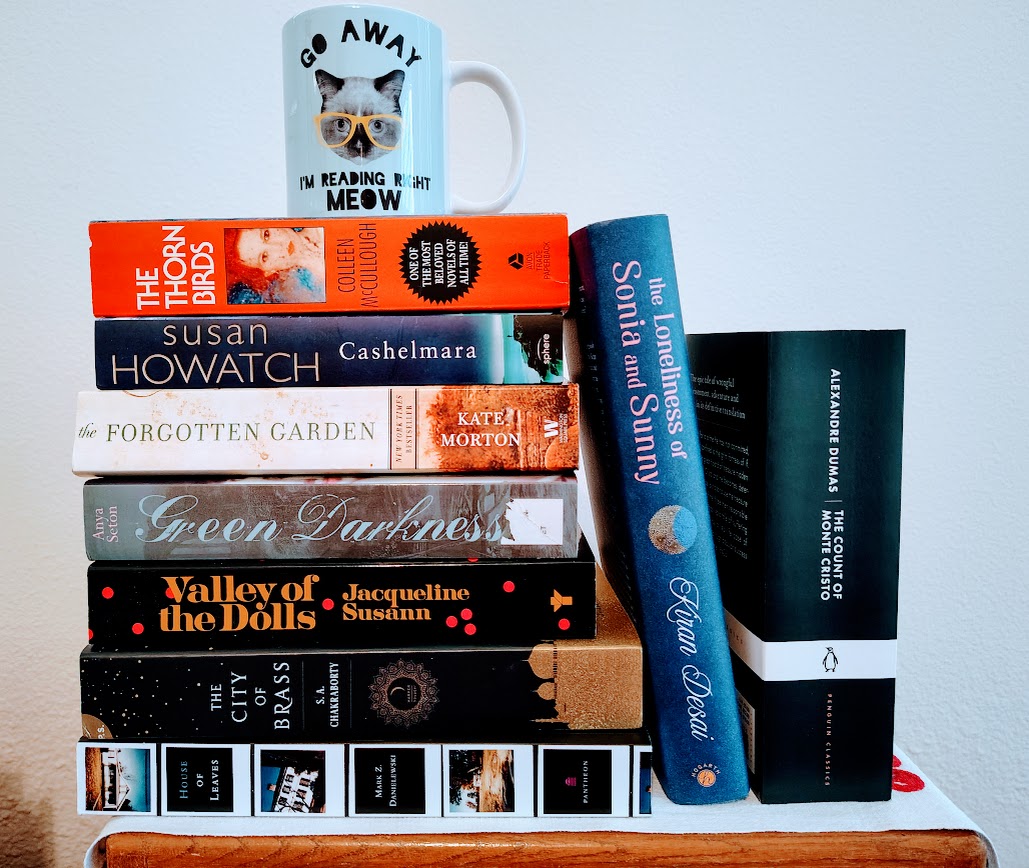
I usually don’t plan on what to read over the year, but after perusing my loaded bookshelves, I plucked out a few that were calling to me and created my own reading challenge. Here is my list.

The Thorn Birds by Colleen McCullough. I read this when it was released in 1977 and decided it was time for a reread since it’s always been one of my favorite romantic sagas.

Cashelmara by Susan Howatch. I don’t know how many times I handled (and caressed) the library copies of this dramatic family saga over the years, and it’s been on my TBR list for years.

Green Darkness by Anya Seton. This is another reread from my long-ago past. I first ran across this back in 1973 when I was hired to work at the West Salem Library. This was one of the first epic time-travel romantic sagas, and I continue to recommend it for those who like the Outlander series.

Valley of the Dolls by Jacqueline Susann. I read this at age 13, which was a bit above my grade level, but I talked the librarian into letting me check it out. I was transfixed. I recently read Gill Paul’s SCANDALOUS WOMEN, a novel about Susann’s journey when writing this, so I decided it was time to do a reread to see if it would still be considered as sordid as I remember.

The Forgotten Garden by Kate Morton. I have read everything by this author except this, and I hear it’s one of her best, so I’ll definitely have a great reading experience.

House of Leaves by Mark Z. Danielewski. This is a dense, odd, and complicated horror novel set in a haunted house. I’ve heard it will blow your mind and make you afraid, very afraid. However, I’m not sure I’m smart enough for this, as one reviewer said, “A love story by a semiotician. Danielewski has a songwriter’s heart as attuned to heartache as he is to Derrida’s theory on the sign.” Okaaaay…

The Loneliness of Sonia and Sunny by Kiran Desai. This is on the Booker shortlist and is loved by Ann Patchett, so what can go wrong? I do hear it’s long and fragmented, so we’ll see if I ultimately finish it.

The City of Brass by S. A. Chakraborty (Daevabad Trilogy). I’m not much of a fan of epic fantasy, but I decided to vary out of my lane a bit. This is the series that rose to the top when I queried my fellow librarians for a good, accessible speculative work of fiction.

And last but not least, The Count of Monte Cristo by Alexandre Dumas. Clocking in at over 1200 pages, this has seen a surge in popularity. I need something to replicate the reading experience I had with the Seven Sisters series, so this may fill the bill.

Do you have any reading lists for the coming year?

Revisiting HELL HOUSE by Richard Matheson

So this was an interesting read in a couple of different ways. Please forgive my rambling review.

I first read this in the 1970s, during my horror phase (which I guess I’m still in), when I read Shirley Jackson’s The Haunting of Hill House and Robert Marasco’s Burnt Offerings. I recall being impressed by how frightening this was and how effectively the setting was portrayed. For some reason, I decided to reread it to see if it affected me the same way it did 50 years ago, and here is what’s different — I don’t remember the obvious uncurrent of sexual tensions of the women, and at times, the lewdness of the house’s history. I’m not judging, I’m just surprised I didn’t remember that aspect of the storyline. However, that all being said, it was still very scary (Stephen King said it was, “the scariest haunted house novel ever written.” I’m not sure I agree with our friend Stevie, as I think The Haunting of Hill House was way scarier in its subtlety.) I did feel the anticlimactic ending went on too long.

I followed up by watching the 1973 movie, The Legend of Hell House, and it was reasonably well done, although somewhat condensed; however, the setting was perfect. (Fun fact: my spouse and I saw this at the local drive-in, probably in the mid-1970s. Near the end, the bathrooms were closed due to a sewer problem, and we had to pee so bad we had to leave before the ending, and it wasn’t until last night that I saw finale!)

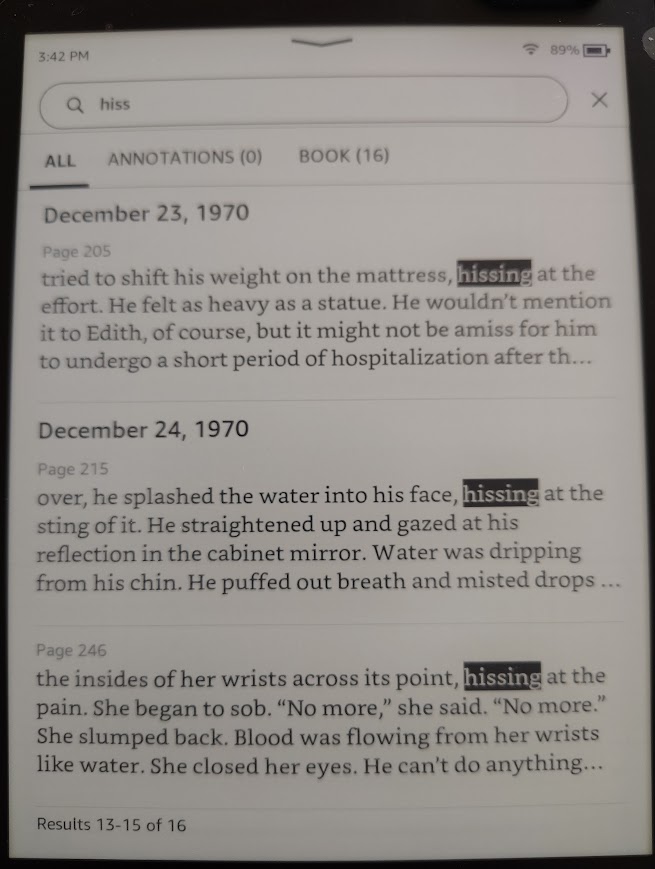
And here’s one more observation that about drove me bonkers during my recent read. Do you ever read a book and notice a repeated term or description that a good editor should have caught? In this case, the word “hiss” (or hissing or hissed) was used sixteen times according to my Kindle!

Richard Matheson also wrote the time travel love story, Bid Time Return, which was adapted into the romantic movie Somewhere in Time, starring Christopher Reeve and Jayne Seymour. (Loved the book but never saw the movie.)

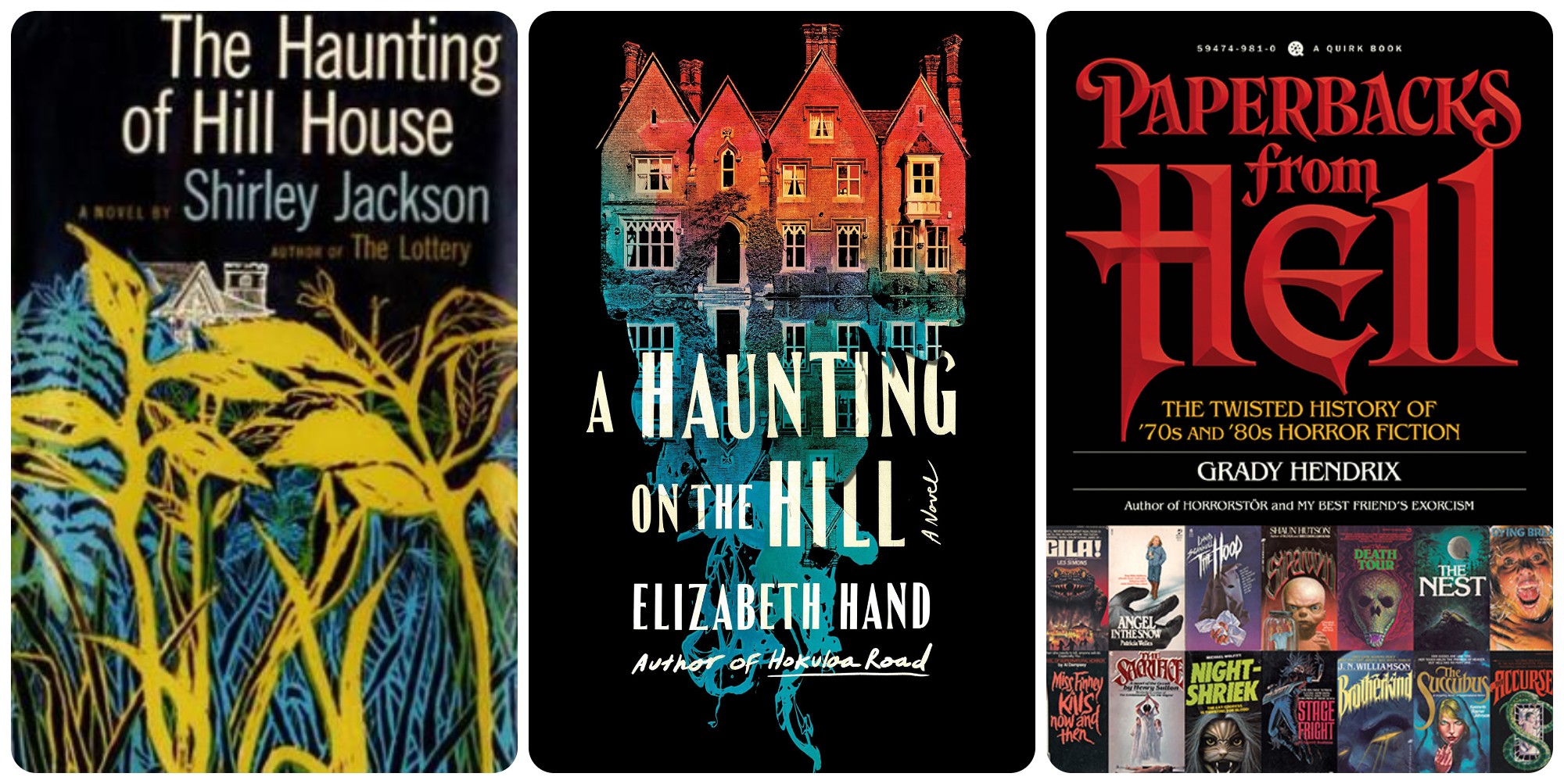
Anyhoodles, if a reader is looking for a good haunted house story, one can’t go wrong with this book as long as the content isn’t objectionable. However, for the best haunted house story ever written (IMO), you can’t go wrong with The Haunting of Hill House (and the original movie, The Haunting), and the sequel, Elizabeth Hand’s A Haunting on the Hill. For a fun look at horror novels from the 1970s/1980s, get a copy of Grady Hendrix’s Paperbacks from Hell (click on the title for my Goodreads review).

2025 MEMOIRS, PLUS A BIOGRAPHY (Part 1)

I love a good celebrity memoir, especially if the author is candid and sprinkles a little dirt. Seven years ago, I wrote about memoirs, which you can read here, if you so desire. Here is a rundown of the memoirs I’ve read so far in 2025. Part 2 will arrive in a few days.

How to Lose Your Mother by Molly Jong-Fast. I read Erica Jong’s ground-breaking novel, Fear of Flying, when it was published in 1973, and then followed her career over the years. Turns out Erica was a bit of a narcissist and an alcoholic. When she started sliding into dementia, not only did Molly become her caregiver, but at the same time, Molly’s husband was diagnosed with pancreatic cancer. Compelling, although some have felt Molly got a little too whiny at times, but you know what? Molly deserved to be a wee bit chagrined over her situation.

Softly, As I Leave You by Priscilla Presley (publication date September 23). Well. This was verrry interesting. There is some repeated information from her first memoir, Elvis and Me, but this continues the story of their divorce and the raising of their daughter, Lisa Marie. Like many celebrities, there is an aggravating air of entitlement throughout, but what is most interesting is what Lisa Marie wrote about Priscilla in her book, From Here to the Great Unknown. While neither could be considered a reliable narrator, it’s interesting to compare what they said about each other — at least it is if you care about this stuff at all, and I do, I do!

Brooke Shields is Not Allowed to Get Old by Brooke Shields. Another entry into the menopausal memoirs by celebrities. It was interesting when Brooke talked about her career and life, but it got a little tedious when she delved into the “change of life” stuff; it’s like no one has ever gone through this before. If you like her, give it a try; otherwise, skip it.

Stay tuned for four more titillating stories by people who think readers want to hear their life stories. Here is a sneak peek:

ON THE HIPPIE TRAIL: Istanbul to Kathmandu and the Making of a Travel Writer by Rick Steves

This was an easy-to-read and fun look at Rick Steves’ first foray into reporting on foreign countries outside of Europe. When he was 23, he took a break from teaching piano (who knew?) and, along with a buddy, decided to travel the “Hippie Trail,” a popular itinerary in the Middle East and South Asia among young people in the late 1970s. As he traveled, he kept a detailed journal, which he found years later and decided to lightly edit the entries and publish, along with providing numerous photos and journal samples.

Despite the “white male privilege” aspects, where his self-awareness went by the wayside a few times, Rick’s journey was fascinating. And while some have criticized his writing skills and observations, one must consider his age and limited life experiences. However, I found the narrative very appealing and think it could be enjoyable to listen to as he narrates the audiobook.

If you are a fan of Rick Steves, pick this up to enjoy the beginnings of his writing and traveling career. This would also make a lovely gift, as the print book features high-quality paper and numerous photos.

After writing the above review, I came across another book with the same itinerary set at the same time period, featuring a very similar cover. Strange Bewildering Time: Istanbul to Kathmandu in the Last Year of the Hippie Trail by Mark Abley was written two years ago. I haven’t read it yet (and am not sure I will), but he appears to have had many of the same experiences as Rick Steves’s, although his perspective includes more of a reflection on the trip and experiences. The reviews are mixed, with some saying it’s well-written (the author is a poet) and some saying it’s not, so who knows.

My Journey With the Seven Sisters (and Pa Salt) by Lucinda Riley

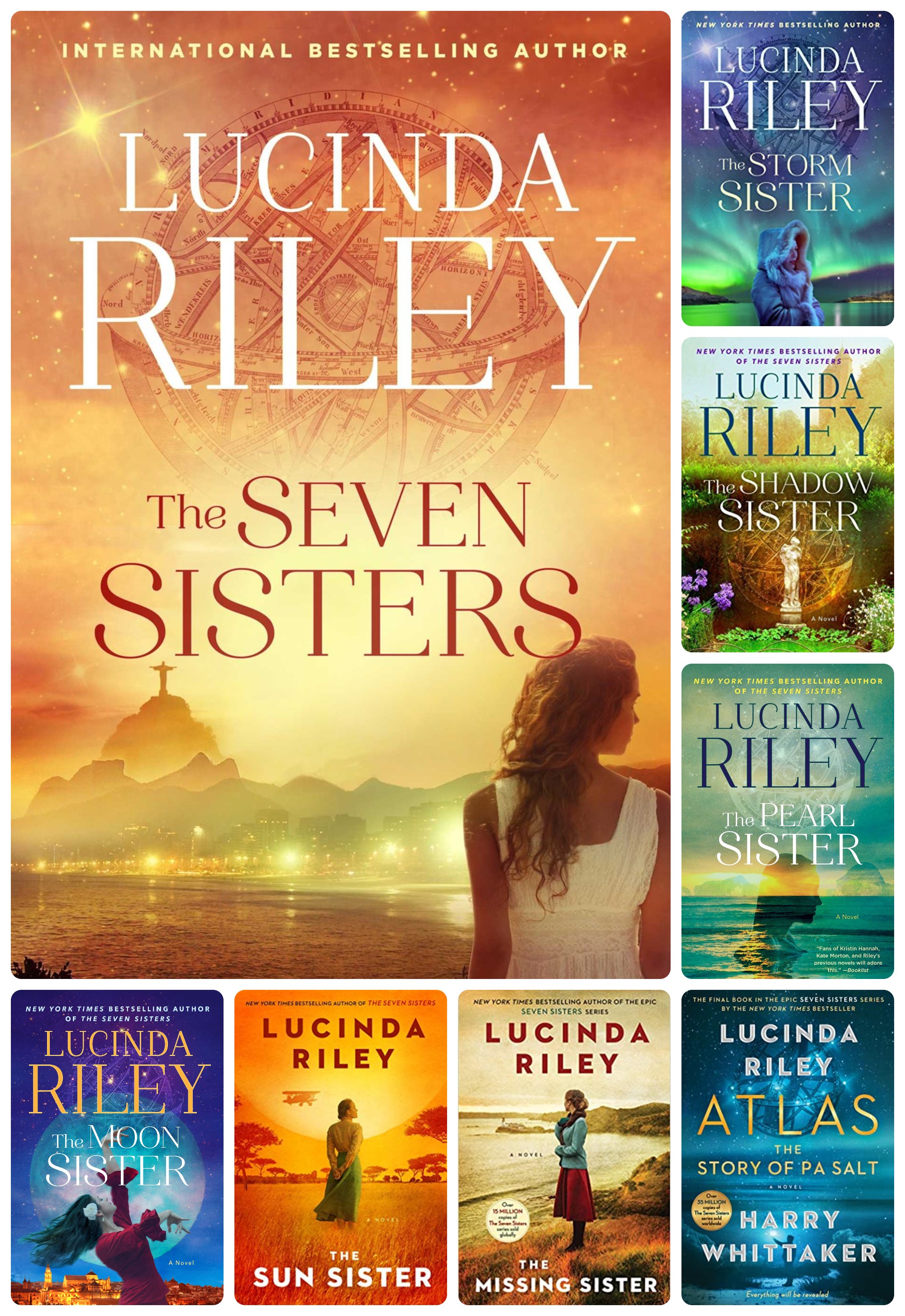
Two years ago, after carrying the large paperback of the first book, The Seven Sisters, in my beach bag for six years, I finally set aside time to start the entire series, which consists of eight long books.

Well, I just finished the last book, Atlas: The Story of Pa Salt, and boy, what a journey that turned out to be!

Each book centers around one of the six sisters adopted by “Pa Salt,” a billionaire, with each one named after a star in the Seven Sisters constellation, also known as the Pleiades. Despite not being exceptionally well-written and sometimes needing a good editor, I enjoyed all the titles. They border on melodrama and were all a tad predictable, but I didn’t give a fig; they all hit the right note for warm summer days on the patio. These books with dual timelines are full of family dynamics, intrigue, and romance, and incorporate some historical figures and history in each exotic setting (Switzerland, Paris, England, Ireland, Australia, Africa, and Brazil), and one has to admire Riley’s research and imagination. If you decide to start on this series, be sure to have the next book readily available, as each ends with a cliffhanger.

My other minor gripe was that these sisters were all smart people, but throughout their upbringing, no one thought to ask their father, Pa Salt, his real name? (I know!)

If you’re a fan of epic novels by Diana Gabaldon, Sara Donati, Beatriz Williams, and Kate Morton, try these addictive books.